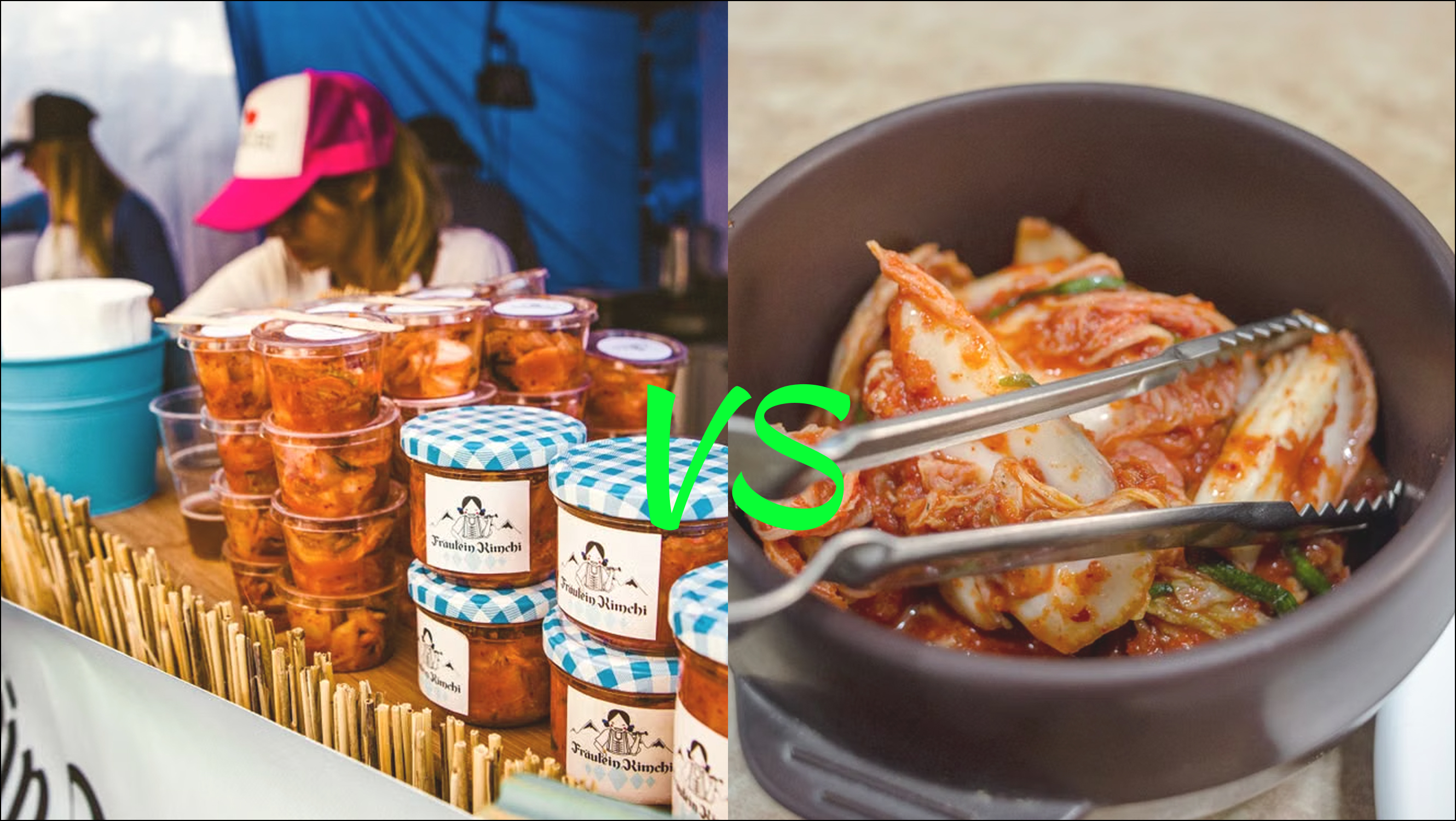
Most kimchi advice online comes down to “homemade is better” without explaining why. We pulled from peer-reviewed food science journals, not cooking blogs, to find out what actually changes between the jar you buy and the jar you make.
Quick answer
Homemade kimchi carries roughly 3x the microbial diversity of commercial kimchi, gives you full control over sodium and fermentation, and costs a fraction per serving. Store-bought wins on convenience and consistency. The variable most people miss: whether the jar contains live bacteria at all.
The Bacteria Are the Whole Point
Kimchi’s health benefits come from lactic acid bacteria (LAB). Same organisms that make yogurt and sauerkraut useful. A fully fermented batch contains 100 million to 1 billion CFU per gram. That’s on par with a probiotic supplement capsule, except you’re getting it from actual food with fiber, vitamins, and minerals alongside it.
Not all kimchi on the shelf is alive, though.
Pasteurization kills the bacteria. A 2019 study in the Korean Journal of Food Science and Technology found that pasteurization dropped bacterial counts from 5.20 to 1.92 log CFU/g. That’s a 99.4% reduction. If your store-bought kimchi is shelf-stable and sits unrefrigerated, the probiotics are dead. Look for jars in the refrigerated section that say “naturally fermented” or “contains live cultures.”
Homemade kimchi doesn’t have this problem. It’s alive by default.
Microbial Diversity: Why Variety Matters
It’s not enough to have bacteria in your kimchi. The type and range of bacteria matters too.
A 2025 comparative study in Microorganisms measured the Shannon diversity index (a standard metric for ecosystem complexity) in traditional vs commercial kimchi:
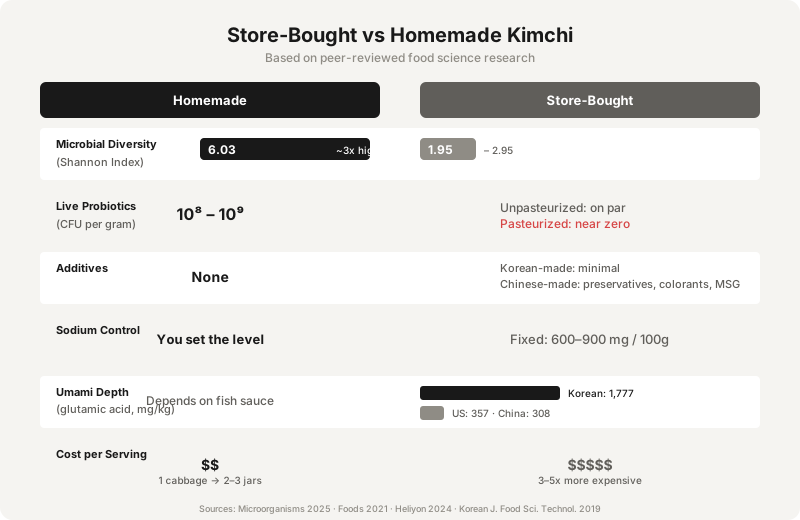
- Traditional/homemade kimchi: Shannon index of 6.03 at week 1
- Commercial kimchi: Shannon index of 1.95–2.95 throughout fermentation
That’s roughly three times the microbial diversity in homemade batches. Commercial kimchi had what the researchers called a “simplified microbial community dominated by a limited number of lactic acid bacteria.” Traditional fermentation maintained multiple species coexisting through natural succession, with different bacteria dominating at different stages, each producing different metabolites.
The researchers noted that traditional fermentation’s gradual acidification “preserves heterofermentative bacteria producing diverse metabolites, potentially offering greater functional benefits through varied bioactive compound generation.” More species, more types of compounds your body can use.
A separate 2025 study identified the dominant bacteria in homemade kimchi as Levilactobacillus (19.2%) and Lactiplantibacillus (12.2%), followed by Pediococcus (6.8%) and Lactobacillus (5.0%). That’s four genera coexisting. Commercial kimchi tends to be dominated by one or two.
What’s Actually In Store-Bought Kimchi?
Not all commercial kimchi is the same. A 2021 study published in Foods compared commercial kimchi from Korea, China, and the United States. The gaps were real.
Additives
Korean manufacturers primarily used natural ingredients and LAB starter cultures. Chinese commercial kimchi used more synthetic additives: potassium sorbate, colorants, sodium L-glutamate, alcohol, and sodium dehydroacetate. American kimchi used fewer traditional ingredients overall and had lower nutritional density.
Check where your kimchi is made. The country of manufacture tells you more about what’s inside than the brand name on the front.
Umami and Flavor
The same study found a 5x difference in glutamic acid (the compound behind umami taste):
| Origin | Glutamic acid (mg/kg) |
|---|---|
| Korean | 1,777 |
| Chinese | 308 |
| American | 357 |
Korean commercial kimchi had far more umami depth. This likely comes down to fermentation duration, fish sauce quality, and the amount of garlic and jeotgal (salted seafood) used.
Antioxidants
Korean commercial kimchi showed about 39% higher antioxidant activity (measured by FRAP assay) than Chinese commercial kimchi. A 2021 study in Molecules found that antioxidant activity in kimchi peaks around day 14 of fermentation. The antioxidant compounds, including organic acids and phenolics, form during fermentation, not from the raw ingredients alone.
The Sodium Question
Kimchi is salty. No way around it.
A typical serving of commercial kimchi contains about 600–900 mg of sodium per 100 g. The 2025 review Kimchi Friend or Foe noted that average Korean sodium intake from kimchi exceeds 1.5 times the WHO recommendation.
With homemade, you control the salt. Reduced-sodium kimchi recipes exist and have been studied. The fermentation still works with less salt, though you need to compensate with slightly lower fermentation temperatures and more careful storage.
Does the Sodium Cause Cancer?
This comes up in every kimchi discussion, so worth addressing directly.
A meta-analysis of 7 studies found a summary odds ratio of 1.31 (95% CI: 0.90–1.90) for the association between pickled vegetables/kimchi and gastric cancer. That is not statistically significant. The evidence is mixed. Some studies show elevated risk, others show no association, and some suggest kimchi may be protective because of its bioactive compounds.
What IS clear: high sodium intake from any source is a risk factor for gastric cancer. Kimchi isn’t special in that regard. If sodium is a concern for you, making your own lets you reduce it. Store-bought gives you no control.
Temperature and Fermentation Control
A 2024 study in Heliyon examined how temperature affects kimchi fermentation:
| Temperature | LAB count by week 1 | pH by week 1 | Dominant bacteria |
|---|---|---|---|
| 4°C (fridge) | 8.29 log CFU/ml | ~5.0 | Lactococcus lactis, Weissella |
| 10°C | 8.42 log CFU/ml | ~4.5 | Lactiplantibacillus plantarum |
| 15°C | 8.49 log CFU/ml | ~4.0 | L. plantarum, L. sakei |
Higher temperatures produce faster fermentation, more metabolite diversity (3,048 distinct metabolites increased at 10°C), and different dominant bacterial species. This is why homemade kimchi tastes different every batch. Ambient temperature, cabbage water content, garlic quantity. All of it shifts the bacterial balance.
Commercial kimchi is fermented under controlled conditions and refrigerated from the factory. Consistent, but less complex.
With homemade, you can do what Korean households have done for centuries: ferment at room temperature for 1–2 days to kickstart the bacteria, then move it to the fridge to slow everything down. That initial warm phase produces a burst of metabolic activity that you can’t get from a jar that’s been cold since the factory.
The Honest Comparison
| Factor | Homemade | Store-Bought |
|---|---|---|
| Microbial diversity | ~3x higher (Shannon 6.0 vs 2.0–3.0) | Simplified, 1–2 dominant species |
| Live probiotics | 10⁸–10⁹ CFU/g when fermented | Unpasteurized = on par. Pasteurized = near zero |
| Additives | None | Varies. Korean-made: minimal. Chinese-made: may include preservatives, colorants, MSG |
| Sodium | Controllable | Fixed (~600–900 mg/100g) |
| Fermentation control | You choose temp, duration, sourness | Factory-standardized |
| Flavor complexity | Varies by batch, season, cabbage | Consistent but simpler flavor profile |
| Umami depth | Depends on your fish sauce | Korean-made: 5x more glutamic acid than US/Chinese |
| Cost per serving | Significantly cheaper | 3–5x more expensive |
| Shelf life | Months (fermentation is the preservation) | 28 days (industry standard) |
| Consistency | Every batch is different | Same every time |
| Convenience | Takes 30–45 min + fermentation time | Ready immediately |
When Store-Bought Makes More Sense
Homemade isn’t always the right call.
If you’re making kimchi jjigae or kimchi fried rice, the microbial differences don’t matter. You’re cooking the kimchi, so the bacteria die anyway. Save your homemade batch for eating raw as banchan.
If you need it to taste exactly the same every time, maybe for meal-prep or picky eaters, commercial delivers that.
And sometimes you just need kimchi tonight. Making it takes 30–45 minutes of active work plus days of fermentation.
When Homemade Is Worth It
If gut health is the reason you eat kimchi, homemade guarantees live, diverse bacteria. No guessing about pasteurization or how long the jar sat in transit.
You set the salt level. Reduced-sodium batches ferment fine with a bit more attention.
One large napa cabbage makes 2–3 jars. The cost math isn’t close.
And the batch-to-batch variation? That’s the feature, not the flaw. Every jar reflects the season, the cabbage, the temperature in your kitchen. Korean grandmothers have been working with that variability for generations.
What to Look for If You Buy
If you’re going store-bought, pay attention to five things:
- Refrigerated, not shelf-stable. Shelf-stable means pasteurized, which means no live bacteria
- “Naturally fermented” or “live cultures” on the label. This means the bacteria are still alive
- Country of manufacture. Korean-made tends to have fewer additives and higher nutritional density
- Short ingredient list. Napa cabbage, salt, garlic, gochugaru, fish sauce (or salted shrimp). If you see corn syrup, potassium sorbate, or artificial colorants, it’s a different product
- Check the sell-by date. Older jars have fermented longer in transit. More sour, more complex, but also more pungent
Make your own
Full kimchi recipe — from salting the cabbage to the first fermentation →
Sources cited in this article: Comparative Microbiome Profiles of Korean Fermented Foods, 2025 · Bacterial Community in Homemade Kimchi, 2025 · Commercial Kimchi Quality: Korea vs China vs USA, 2021 · Effect of Pasteurization on Kimchi, 2019 · Temperature Impact on Kimchi Fermentation, 2024 · Health-Promoting Constituents of Kimchi, 2021 · Kimchi Friend or Foe, 2025 · Pickled Vegetables and Gastric Cancer Meta-Analysis, 2020