Korean Fried Chicken: What Makes It Different
Korean fried chicken explained — starch batter, the double fry, and the sauce families. Why it is crispy instead of crunchy, and why the sauce does not sog it.
What's in this recipe
Ingredients
Base recipe makes 4 servings
- 1wholechicken (about 4 lbs), cut into 10 pieces, bone in
- 0.5cuppotato starch
- 0.25cupall-purpose flour
- 0.5tspbaking soda
- 2largeeggs
- 3Tbspgochujang
- 3clovesgarlic, minced
- 0.33cupketchup
- 0.33cuprice syrup
- 2tspvinegar
- 1Tbsptoasted sesame seeds
- 1.5Lneutral oil for frying
Substitutions
No exact match? These work.
Potato starchTapioca starch or cornstarch
Same gluten-free logic. Potato starch gives the thinnest, hardest crackle.
Rice syrupCorn syrup or honey
Honey burns faster because of its sugar content. Lower the heat if you use it.
Whole chicken, bone inDrumsticks or wings
Faster and more forgiving. Cuts frying time roughly in half.
GochujangSriracha
Works in a pinch. It reads thinner and more vinegar-forward than gochujang.
Equipment
- Deep pot or Dutch oven (oil at least 3 inches deep)
- Fry thermometer (not optional here)
- Wire cooling rack set over a sheet pan
- Fine mesh skimmer
- Instant-read meat thermometer
How to Make It
Whisk the potato starch, flour, and baking soda together, then beat in the eggs. Maangchi's test: the batter should be thick enough that by the time you finish coating the chicken there is almost nothing left in the bowl.
Heat the oil to 330°F (165°C). Dry the chicken pieces, coat them, and fry in batches without crowding the pot.
First fry: about 12 minutes, until just barely colored. Pull the pieces and rest them on a wire rack for 10 minutes. This is where most of the magic happens, so do not skip it.
Bring the oil up to roughly 370°F (190°C) and fry the same pieces a second time, 10 to 12 minutes, until deep golden. Internal temperature should read 170°F. The second fry drives out the steam that settled in the crust during the rest.
While the chicken rests after the second fry, simmer the sauce: garlic, ketchup, rice syrup, vinegar, and gochujang in a wide pan until bubbly.
Toss the hot chicken in the sauce a few turns only, scatter sesame seeds, and serve immediately. Long tosses and a waiting table are what make it soggy.
Expert Tips & Common Mistakes
- A fry thermometer decides this dish before you start. Oil drops hard when chicken goes in; let it climb back before the next batch or you get greasy, pale crust.
- Cool on a wire rack, not paper towels. Trapped steam is the enemy, and paper holds it against the crust.
- Scoop the fine debris out between batches with a mesh skimmer. Left in, it burns and dots the next batch with black specks.
- A young bird under 5 lbs has sweeter, more tender meat, and it fries more evenly. Modern Pepper's tip, and it is worth hunting for one.
- In a hurry? Chef Ji Hye Kim says the secret is the batter, not the double fry. Keep the dry mix starch-heavy, add a splash of vodka to the wet batter, and one fry at 350°F gets you close.
- Make the pickled radish a day ahead. It tastes better after 24 hours in the brine anyway.
About this dish
American fried chicken gives you a thick, seasoned crust you bite through. Korean fried chicken gives you a thin, glassy one that breaks. Same bird, opposite textures, and the gap comes down to two choices: starch instead of flour, and frying the chicken twice.
What Is Korean Fried Chicken?
Korean fried chicken is usually bone-in chicken, dredged in a coating that leans heavily on potato or tapioca starch, deep-fried, rested, fried again, and tossed in sauce right before it hits the table. The sauce matters, but the crust is the point of the dish. Every other decision in the method, from the cure to how the oil is managed, exists to get that crust thin enough to shatter and dry enough to survive being wet.
The double fry is the part people question. The reason it exists is moisture. The first fry cooks the chicken through and sets the crust. During the rest, water from the meat moves outward into that crust. The second fry, hotter, is a drying pass: it boils off the water the crust just absorbed and hardens the shell. Maangchi describes it as removing the hot steam trapped inside after the first fry, and NPR’s breakdown of the double-fry science lands on the same physics. And that rest between the two fryings does as much work as either fry. Skip it and you have good fried chicken with a shelf life of about five minutes.
Eric Hang, a chef quoted in the NPR piece, has the cleanest way of naming the texture: crunchy uses your molars, crispy is more of a front-teeth thing. Korean fried chicken lives at the front of the mouth. A bready, American-style coating is crunchy food. This one is supposed to make a small sound when it breaks.
The sauces are a family, not a single recipe. The one most foreigners know is yangnyeom, which is gochujang, garlic, ketchup, and rice or corn syrup simmered into a sticky, tangy glaze. Ganjang, a soy-honey sauce, skews salty-sweet and works fast because the sugar in it burns if you dawdle. Butter-cheese powder, the Dali-style dusting, sounds like a gimmick and is not. Confit garlic versions bury the chicken under soft, golden cloves. Doobydobap’s method covers all four with exact quantities, and the recipe page below has that link.
One habit ties all of it together, and it explains why sauce does not ruin the crust: tossing happens in the last few seconds before serving. The shatter-proof shell the double fry creates buys you minutes, not hours. Chicken delivered in Korea arrives sauced or unsauced for the same reason.
What to Serve Korean Fried Chicken With
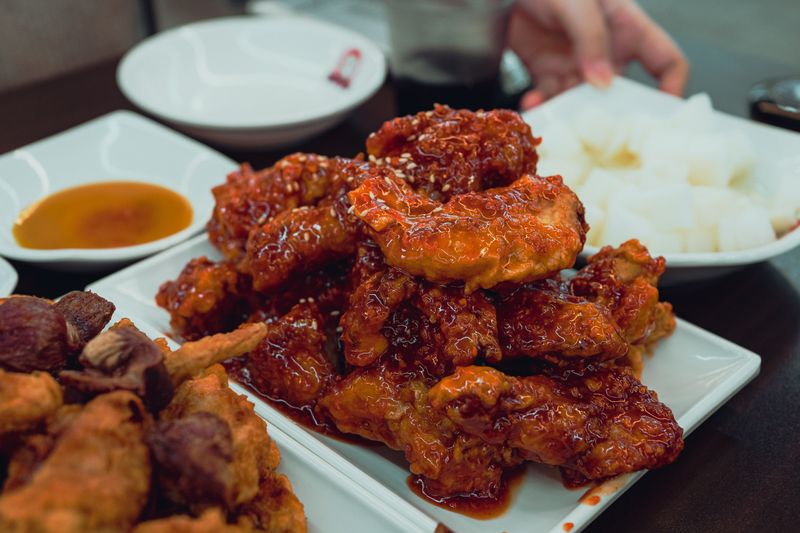
Chicken mu first, before anything else. Cubes of Korean radish pickled in a straight vinegar-sugar-salt brine, eaten cold between bites of hot, fatty chicken. It is the acid that resets your palate, and in Korea the refills are free because nobody orders only one container. Modern Pepper brags about asking for three or four.
After that, this is chimaek (치맥), the chicken-and-beer combination, and the drink is arguably a side dish. Cold lager or soju. A whole generation’s Friday nights are built on it, and the delivery culture exists around it: chicken arrives 30 minutes later, so restaurants engineer the crust to survive the ride.
If you want it to function as a proper meal rather than a drinking snack, add tteokbokki as a second plate, or rice, kimchi, and a simple soup. The Korean fried chicken we walk past on the way to other foods is also the chicken sitting on most banchan-free, late-night tables.
For the full method with cure weights, dredge ratios, and all four sauce formulas, go to the Korean Fried Chicken Recipe. The five ways to cook Korean chicken generally, braised and soy-braised included, are in Korean Chicken Recipes.
Nutrition per serving
Source: U.S. Department of Agriculture, Agricultural Research Service. FoodData Central, 2019. fdc.nal.usda.gov
Frequently Asked Questions
What makes Korean fried chicken different from American fried chicken?
The coating and the fry. Korean chicken uses a thin, starch-heavy batter instead of a thick, bready flour coating, and it gets fried twice. The result is a glass-like crust that shatters rather than a soft one you chew through. It also stands up to sauce without going soggy, which American-style coating never does.
Why do you double fry Korean fried chicken?
The first fry cooks the meat. During the rest after it, moisture from the center migrates into the crust. The second fry at a higher temperature drives that moisture back out. Maangchi's version of this: after the first fry it looks crunchy but inside is hot steam, and the second fry removes the steam. That is the whole difference between crispy and merely cooked.
What starch is best for the batter?
Potato starch or tapioca starch. Neither has gluten, so the crust sets thin and hard instead of thick and breadlike. Doobydobap's ratio is 90 percent flour to 10 percent starch in the dredge; Maangchi goes mostly potato starch for a harder, glassier shell. Cornstarch works too, just with a lighter crackle.
What is the yellow pickled radish that comes with it?
Chicken mu (치킨무), cubes of Korean radish pickled in vinegar, sugar, and salt. It is the palate cleanser, and the acid and crunch cut the fat of the chicken every time you take a bite. Modern Pepper jokes about asking for three or four refills at every chicken place. Most people do.
Can I skip the double fry at home?
Yes, if the batter is right. Chef Ji Hye Kim's line is that the double fry is mostly for batching, and the real secret is the batter: keep it starch-heavy, add a splash of vodka to the wet mix (it inhibits gluten and evaporates fast), and fry once at 350°F until golden. You lose some of the shatter. You do not lose the dish.