Samgyeopsal: Korea's Grilled Pork Belly BBQ
Samgyeopsal: Korea's Grilled Pork Belly BBQ — thick-cut pork belly grilled over charcoal, the king of Korean BBQ.
Introduction
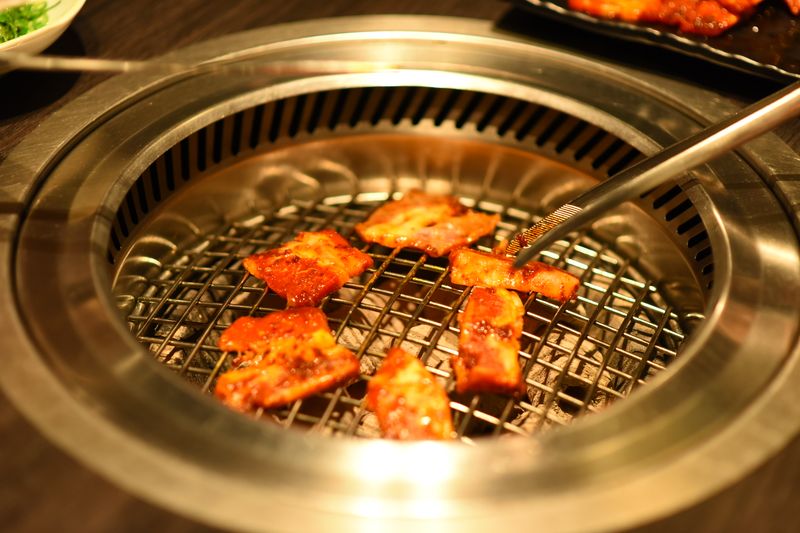
Samgyeopsal is the most popular meat in Korean barbecue, and it is the simplest. Pork belly, salt, fire. That is the recipe. No marinade, no sauce — just salt. You salt the meat, throw it on the grill, and eat it wrapped in a lettuce leaf with ssamjang and raw garlic. The name means three-layer meat — you can see the skin, fat, and meat stacked in distinct layers when you look at the cross-section. That fat is the whole point. As it renders on the grill, it crisps the outside and keeps the inside juicy. You want it 2 centimeters thick, about three-quarters of an inch. Thinner and it dries out. Thicker and the outside burns before the inside catches up. Most Korean butcher shops sell it pre-sliced at exactly this thickness. Salt both sides, let it sit at room temperature for 20 minutes, then grill. Charcoal is better than gas, and outdoor is better than indoor, because this meat throws a lot of oil. But a deep pan with a lid that is slightly smaller than the pan — set it on top to catch the splatter — works fine on a stovetop. Cook until golden brown on the outside, rest it for a minute, then cut with kitchen scissors into bite-sized pieces. That is the dish. Everything else is what you wrap it in.What's in this recipe
Ingredients
Base recipe makes 4 servings
- 800gpork belly, skin-on, boneless, cut 2cm thick
- 1tbspcoarse salt
- 1headgarlic, sliced or whole
- 1headbutter lettuce or red leaf lettuce
- 8leavesperilla leaves (kkaennip)
- 4tbspssamjang (Korean BBQ dipping sauce)
- 2tbsptoasted sesame oil
- 1tspblack pepper
- 1cupkimchi (optional, for grilling)
Substitutions
No exact match? These work.
Pork bellyPork shoulder (butt)
Less fat, not the same richness but still works for Korean BBQ.
SsamjangMix doenjang (2 parts) + gochujang (1 part) + sesame oil + garlic + green onion
This is literally what ssamjang is. Store-bought is fine too.
Perilla leaves (kkaennip)Extra lettuce
You lose the minty, peppery flavor perilla brings. Shiso leaves (Japanese) are a closer match.
Toasted sesame oilPerilla oil
Nuttier, more Korean, even better if you can find it.
GarlicNone
Garlic is non-negotiable in samgyeopsal.
Equipment
- Charcoal grill or gas grill (preferred) or deep frying pan with lid
- Kitchen scissors
- Tongs
- Cutting board
How to Make It
Pat the pork belly dry and season both sides generously with coarse salt and black pepper. Let it sit at room temperature for 20 to 30 minutes. This draws out surface moisture and helps the meat crisp up.
Prepare the grill or pan. For charcoal: heat to medium-high until the coals are covered in white ash. For stovetop: use a deep pan over medium heat with 1 teaspoon of cooking oil. Place a lid that is slightly smaller than the pan on top to catch oil splatter.
Place the pork belly on the grill or pan, fat side down first. Cook until the outside is deeply golden brown and crispy, about 4 to 5 minutes per side. Do not move the meat while it is searing — let the crust form.
If cooking on a stovetop, pour off excess oil partway through. Continue cooking until both sides are browned and the internal temperature reaches 63°C (145°F).
Transfer the cooked pork belly to a cutting board and rest for 2 to 3 minutes. Cut into bite-sized pieces with kitchen scissors.
Prepare the ssam: lay a lettuce leaf in your palm, add a perilla leaf, place a piece of pork, a smear of ssamjang, a slice of raw or grilled garlic, and a piece of grilled kimchi if you have it. Fold it up and eat it in one bite.
Expert Tips & Common Mistakes
- Salt both sides and let the meat rest at room temperature before grilling. This is not just seasoning — it firms up the meat and helps it crisp.
- Charcoal is always better than gas for samgyeopsal. The smoke adds a flavor you cannot get indoors.
- Use kitchen scissors, not a knife. Korean BBQ scissors cut through pork belly cleanly and let you portion at the table.
- Grill the kimchi alongside the pork. Aged sour kimchi from the fridge, grilled in the rendered pork fat, is one of the best things in Korean cooking.
- Two dipping styles exist: ssamjang (the original, bold and funky) or salt + pepper + sesame oil (the purist, lets the pork speak). Both are correct.
- Do not trim the fat. The fat renders, crisps, and keeps the meat juicy. Without it, you are eating a different dish.
About this dish
What to Serve Samgyeopsal With
Samgyeopsal is the centerpiece, not the whole meal. The table around it matters as much as the meat itself.
Ssamjang goes on the table in a small dish. You dip or spread, depending on how much you want in each bite. Salt and pepper mixed with sesame oil is the second dip, for when you want to taste the pork without the funk of fermented paste. Raw garlic slices and green chili peppers sit next to the ssamjang. Perilla leaves and lettuce leaves stack up on a plate. You build each wrap yourself: leaf, meat, sauce, garlic, maybe a piece of grilled kimchi. Fold it. Eat it in one bite. That is the whole system.
Kimchi is non-negotiable, and the best move is to grill it alongside the pork. Take aged sour kimchi from the fridge, lay it on the grill in the rendered pork fat, and cook it until the edges char slightly. It softens and caramelizes, absorbing everything the pork left behind. Cooked kimchi like this is better than fresh kimchi with samgyeopsal — the acidity cuts through the fat, and the smoky char matches the grill.
For sides, keep it simple. Seasoned bean sprouts (kongnamul Muchim) and spinach (sigeumchi Namul) are the standard banchan. Both are quick to make and both are served cold, which contrasts with the hot, fatty meat. Steamed rice is optional. Some people eat it, some skip it entirely and just fill up on meat and wraps. If you are eating outdoors with charcoal, a cold beer is the drink. Inside, soju does the job.
You need ssamjang for the wraps. Grill kimchi in the pork fat. For the full grill setup, see the Korean BBQ recipe.
Nutrition per serving
Source: U.S. Department of Agriculture, Agricultural Research Service. FoodData Central, 2019. fdc.nal.usda.gov
Frequently Asked Questions
What cut of pork is samgyeopsal?
Samgyeopsal is pork belly — specifically the skin-on, boneless cut. The name means three-layer meat in Korean, referring to the visible layers of skin, fat, and meat. It is always grilled in Korean BBQ, never braised or stewed.
How thick should samgyeopsal be cut?
2 centimeters, about three-quarters of an inch. This is thick enough to get a crispy exterior while staying juicy inside. If it is thinner than 1.5cm it will dry out on the grill.
Samgyeopsal vs galbi — what's the difference?
Samgyeopsal is plain pork belly, grilled with just salt. Galbi is marinated beef short ribs. Different meat, different marinade, different cut. Samgyeopsal is the simpler, more everyday option.
Do you eat the fat in samgyeopsal?
Yes, that is the whole point. The fat renders on the grill and turns crispy and golden. You wrap it with ssamjang, garlic, and vegetables to cut through the richness.
What is ssamjang?
Ssamjang is the standard Korean BBQ dipping sauce — a mix of doenjang (fermented soybean paste) and gochujang (red pepper paste) with sesame oil, garlic, and green onion. You can buy it pre-made at any Korean grocery store.